
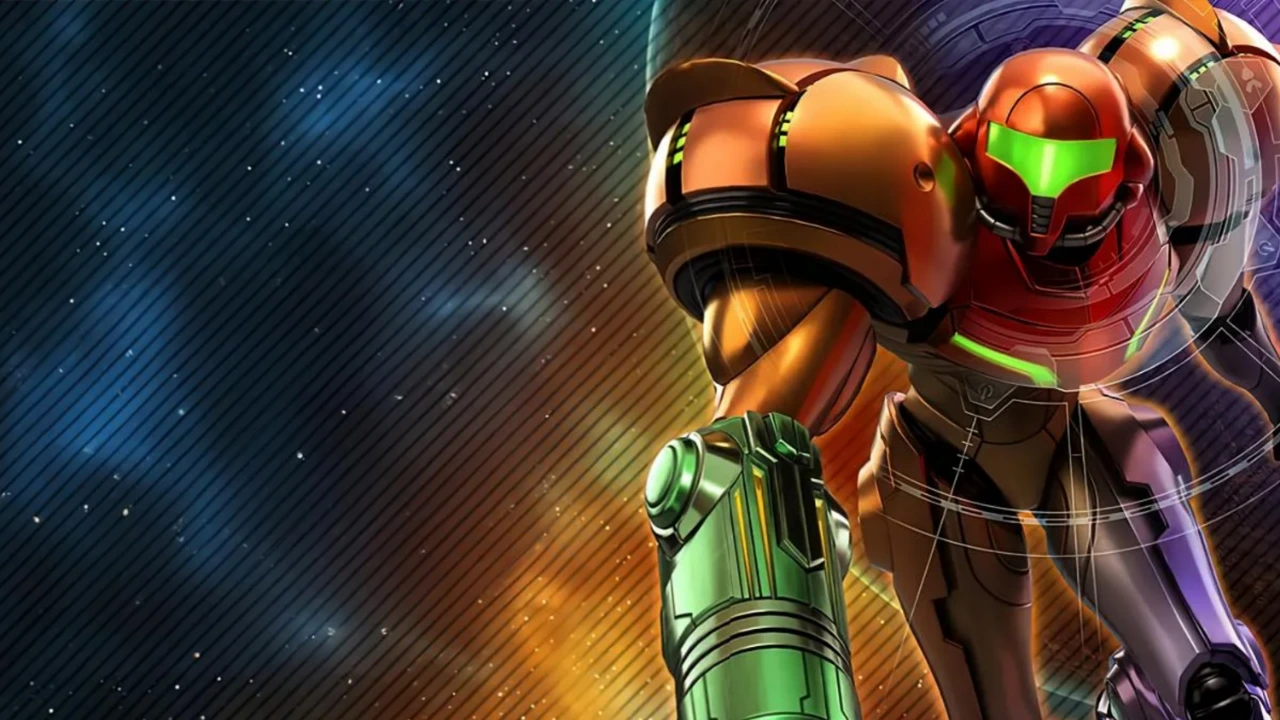

Is there anything to say about Metroid Prime that hasn't already been said?
I could talk about the unique and never-replicated approach to a first-person game. I could go on about the incredible atmosphere and presentation. I could wax eloquent about the series' masterful transition of the franchise from 2D to 3D under Retro Studios' meticulous care. I could talk about all of this and more. However, that's all been said before in so many ways, by so many people, so it initially felt like a bit of a waste of breath. But I figure, if even one more person is converted into a Metroid fan by what I have to say, then isn't it all worth it in the end? So allow me to add to the noise. If you're already a Metroid fan, chances are there won't be much new for you here so please indulge me. But if you're new to Metroid and wondering what all the hubbub is about, read on! Allow me to make a Samus Aran enjoyer out of you.
My first Metroid game was actually Fusion on the Game Boy Advance. It's a much more linear and exposition-heavy experience than most Metroid games, and while it's still a fantastic game, it thus finds itself a topic of much debate among the Metroid faithful. But for a young Brayden with very little exposure to any kind of survival horror, Fusion's slightly more curated adventure was the gateway drug I needed to get addicted to the larger Metroid games and mythos. That game led me directly to Metroid Prime on the GameCube. And let me tell you, whether you're playing that original GameCube version, the "New Play Control!" Wii version, or the Switch remaster, "Prime" is the most apropos word Retro could have chosen to describe this game.
The Light Of Samus Aran
From the moment the Nintendo logo shows up as the game boots, and you hear the first unsettling notes of the main theme - a disturbing and dark amalgamation of organic and mechanical sounds - the mood is set. Metroid Prime was, at the time, Nintendo at it's darkest, scariest, and most serious. For my money, that mature presentation from Nintendo has only ever been topped by Prime's direct sequel, Metroid Prime 2: Echoes. That the House of Mario would ever give Retro Studios so much freedom to create such a foreboding and non-family-friendly atmosphere will forever be astonishing to me.
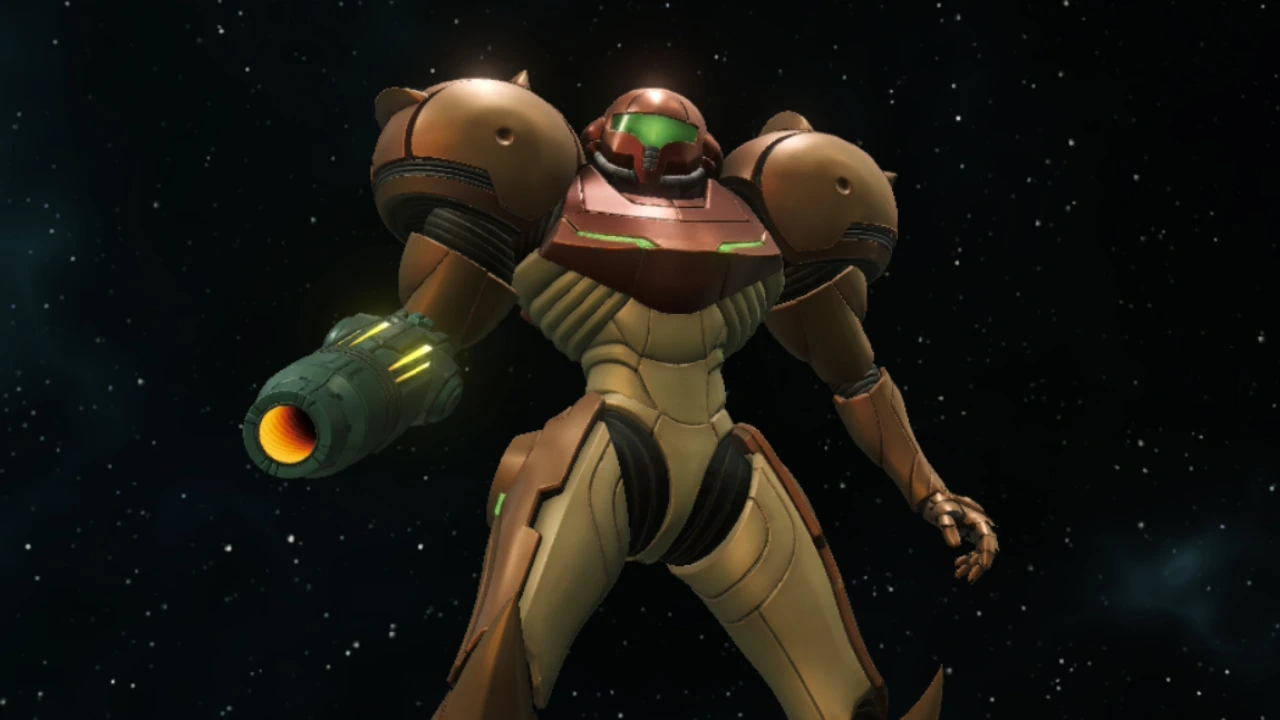
As you start the game, you're dropped straight into Samus' shoes as she responds to a distress signal from a frigate orbiting the planet Tallon IV. You learn everything you need to know about who Samus is the moment she disembarks her ship with a jumping flip and a hero landing. Samus Aran is a badass, and she knows it. She's here to kick ass, take names, and figure out what in the hell happened to this research frigate, designated Orpheon. She presents to the audience as a beacon of light in an otherwise oppressively dark setting.
Turns out Frigate Orpheon belongs to the Space Pirates, Samus' archenemies. The Pirates' science teams have been performing some kind of genetic experiments on the fauna of Tallon IV, and something has gone terribly wrong. Dead or dying Space Pirates litter the causeways, and multiple containment pods are breached or are at critical integrity. Eventually Samus chases the Pirates down to the surface of Tallon IV, the tutorial/prologue ends, and it's here that your adventure really begins in earnest. The suffocating death and claustrophobia of the Orpheon gives way to the lush, green, and very alive rainforest of the Tallon Overworld.
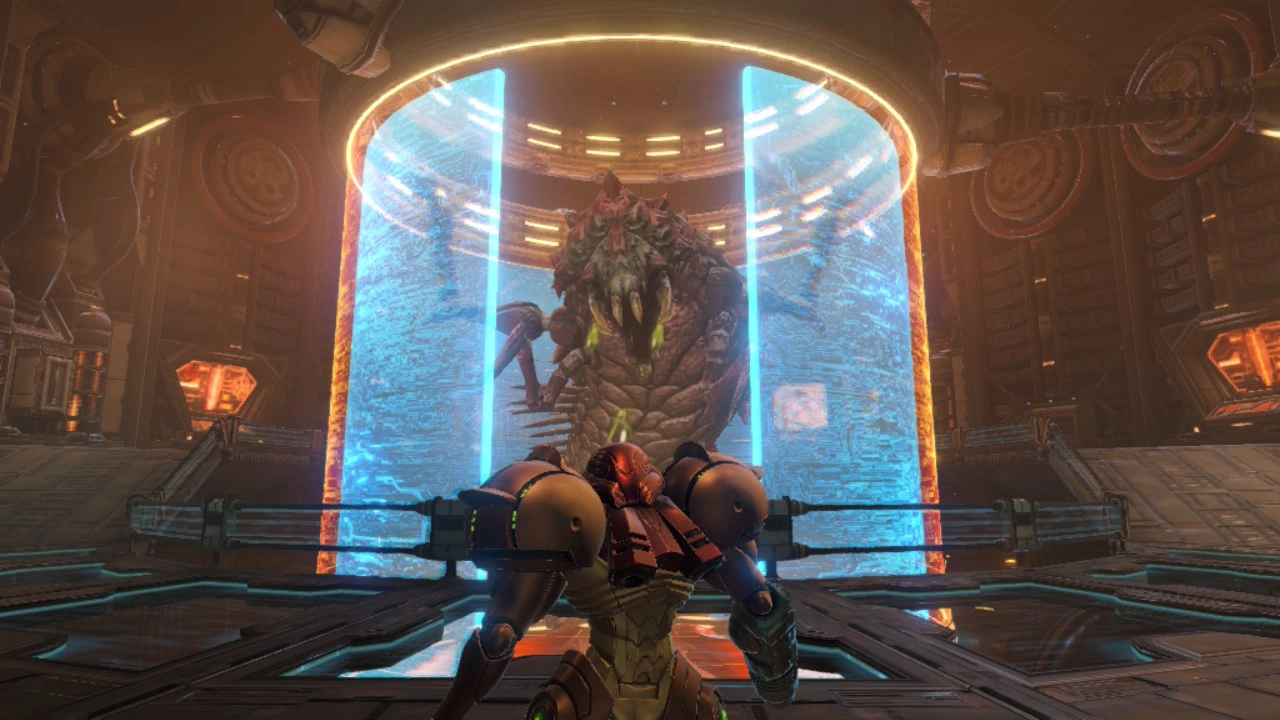
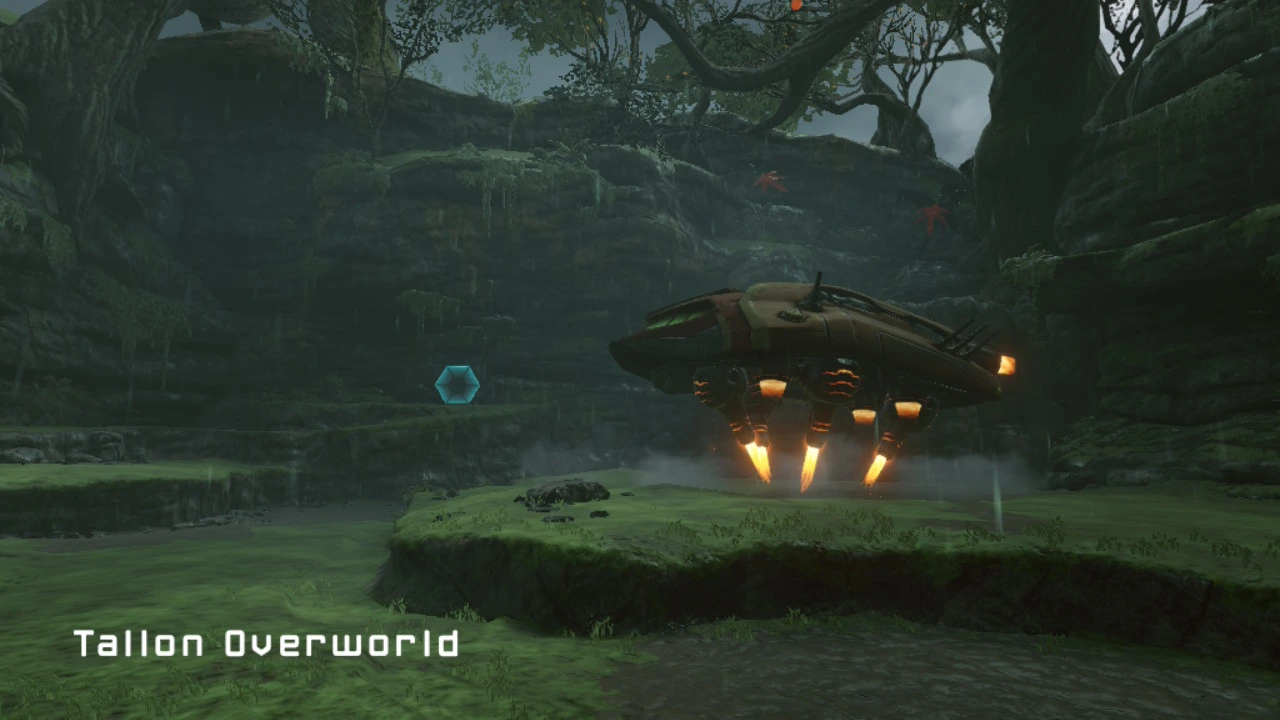
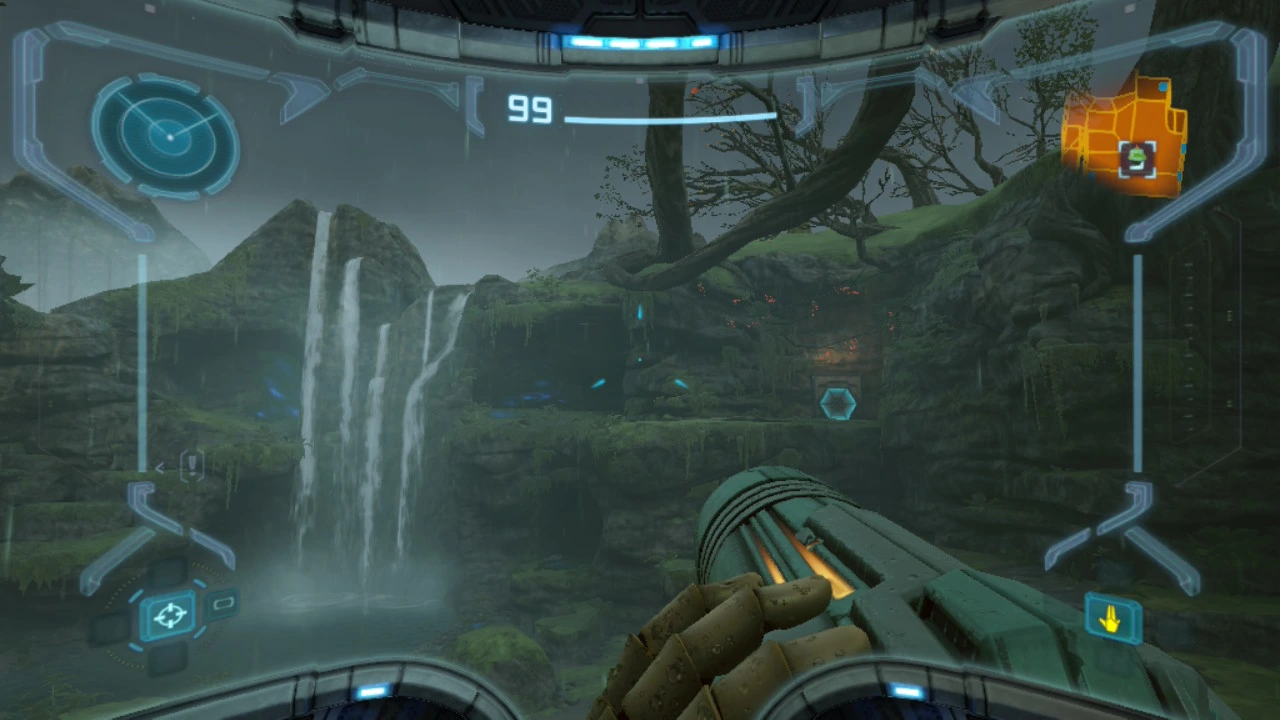
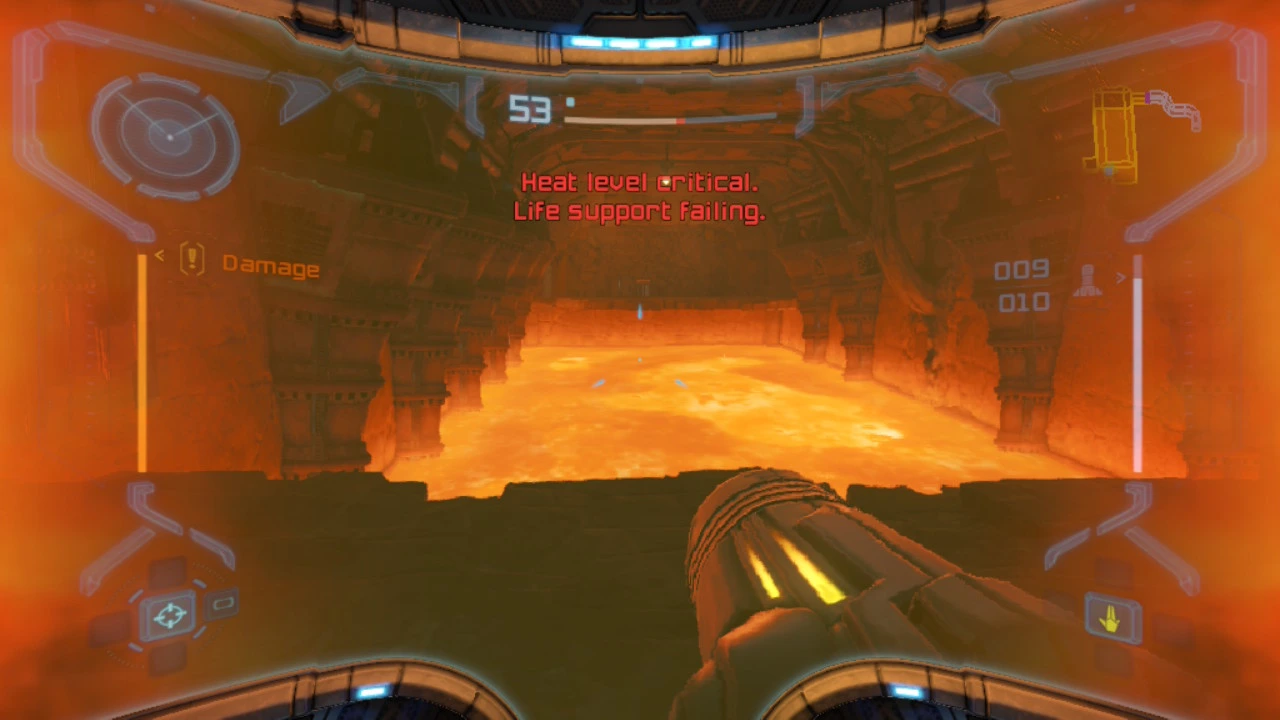
Even before reaching the planets' surface however, the game sets itself mechanically apart from other first-person games. Famously, Retro and Nintendo presented a united front against a skeptical fan base during Prime's development, referring to the game not as a first-person shooter, but as a "first-person adventure", and it remains an important distinction. Metroid Prime is a first-person game, and you do shoot, but it's not a first-person shooter in the conventional sense. You will not spend the majority of your time mowing down waves of mindless enemies. You will not be trying to get to the end of a linear level. Tallon IV is a living, breathing world, with biomes, ecosystems, and a vast labyrinth of interconnected environments for Samus to attempt to traverse as she unravels the Space Pirates' motives for even being here. The major antagonist becomes the planet itself, in a sense, as local wildlife treats you as prey, magma rivers threaten to burn you alive, and rogue machines long abandoned by a lost civilization attempt to eradicate an unwanted intruder. Not to mention the deadly mutagenic substance of unknown origin, seeping its way into everything, turning environments deadly and animals deadlier.
Data Received
That's a lot to deal with on its own, but on top of all that, Metroid Prime doesn't spoonfeed you your objective. It rarely hands out waypoints, and Samus is well and truly alone. Nobody's speaking to you over comms. You're largely going to have to get by with your own wits. Herein lies the brilliance of Metroid as a series. You're not just trying to get from point A to point B. You're trying to use the tools you've got in order to figure out where you can go at all. Upon reaching somewhere new, you'll often be rewarded for your curiosity with more tools, whether stolen from Space Pirates, or left behind for Samus by a long lost clairvoyant civilization of bird-like Chozo. These new tools in turn open more paths to you, and so the gameplay loop emerges. It's addictive and so, so satisfying.
Metroid Prime depends upon your desire to discover and uncover. If all you want to do is rush the objective, then Metroid, and the metroidvania genre at large, might not be for you. You'll find yourself traversing and re-traversing environments multiple times with different tools at your disposal each time you pass through on your way to some larger objective. Though much has been made about the supposed sin of "backtracking" in games, it behooves the player to do so in Metroid, because it will be impossible to claim every goodie in a region during your first visit. Seeing an item or powerup you can't get, and remembering it later once you have the right tool to go back and get it is, a unique type of dopamine rush, but you have to want it in the first place.
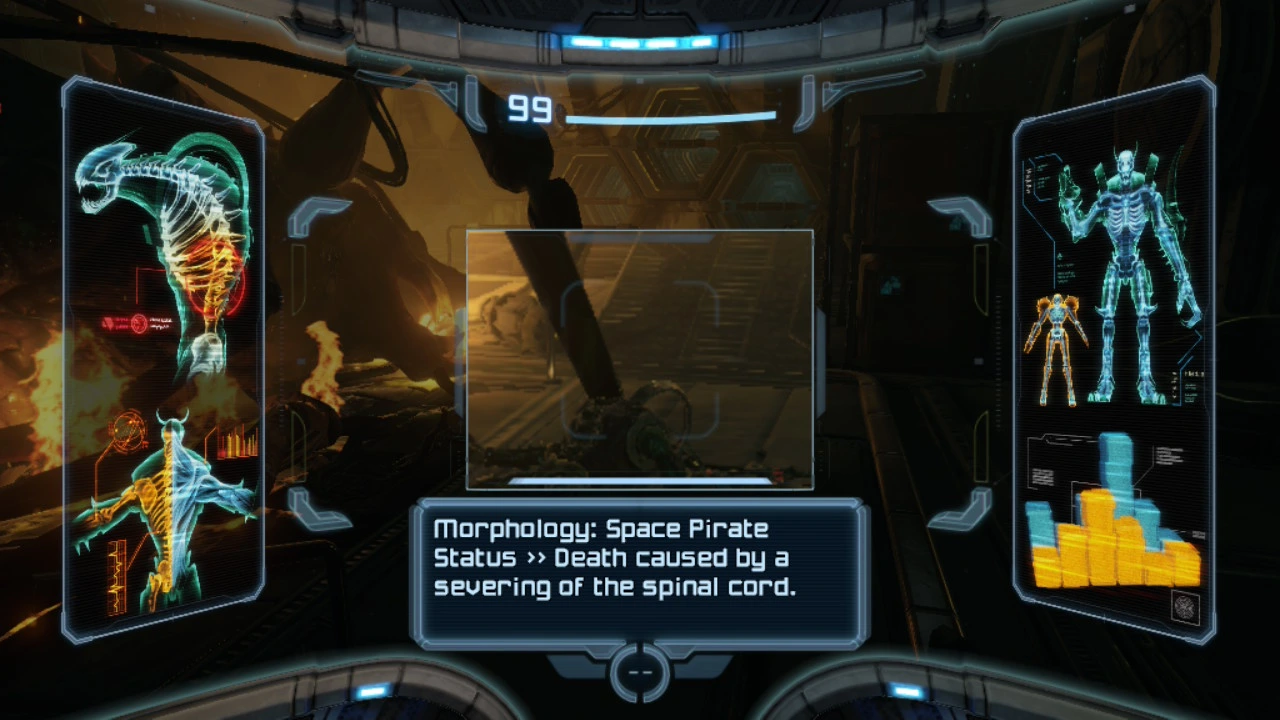
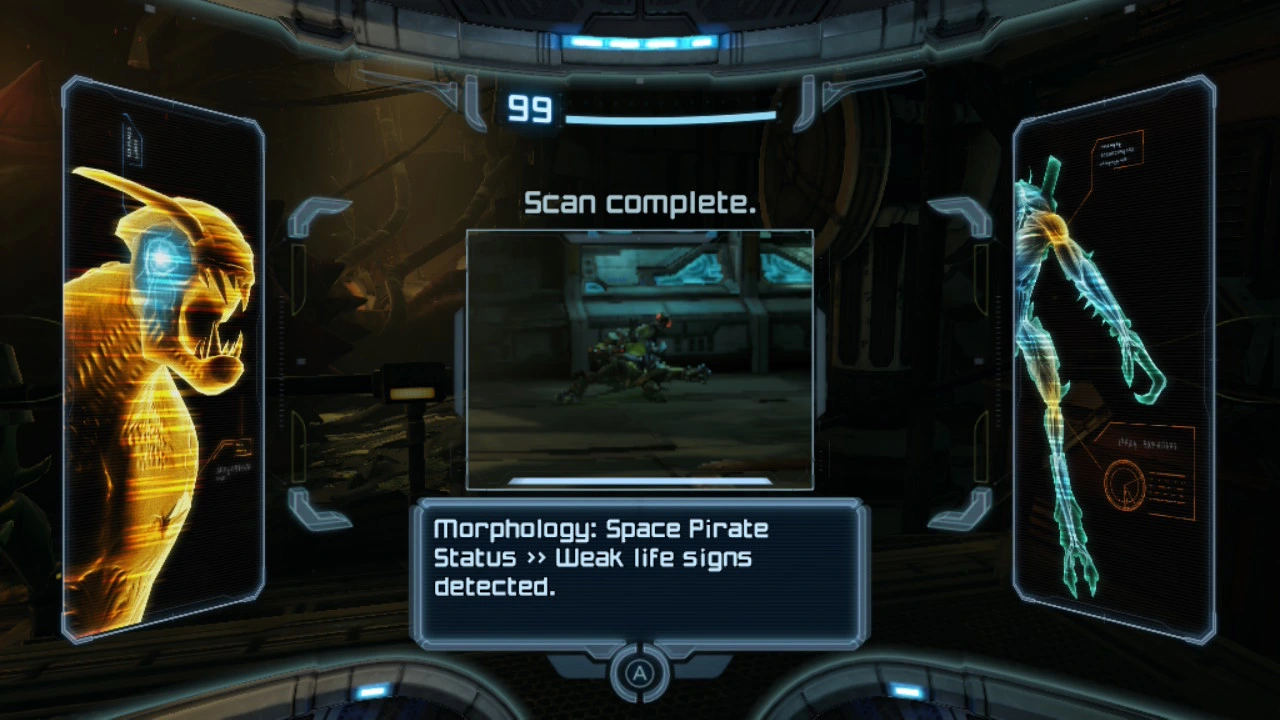
And you will want to find all those tools, too. Samus begins her time on Tallon IV in a weakened state for reasons I'll allow new players to experience on their own. When you touch down, all you've got are your Power Beam and your Scan Visor. The Power Beam is self explanatory, so let's talk about the Scan Visor. This is how Metroid Prime establishes itself as unique versus other first-person games. By activating the Scan Visor, Samus can, well, scan objects and creatures in her environment to get a short text readout about that thing. Just about every single thing Samus can interact with can be scanned, and scan you must! Without the Scan Visor, Samus will have very little idea what she should be doing or where she ought to go.
Recorded In Logbook
Maybe scanning that mural on the wall will tell you something about what happened to the lost Chozo civilization. Maybe that computer console tells you what traps the Space Pirates have laid for you up ahead, or what their purpose is on Tallon IV. Scan a creature to learn about its morphology, its behaviour, and its potential weaknesses. Scan that crack in the wall to find out what material it's made of, informing what sort of tool might destroy it. Important information will be stored in your logbook for perusal at your leisure, but you can read the short version immediately upon scanning. Strictly speaking, you don't need to scan anything, except in specific situations like activating a machine or computer, but you're going to have a much harder time navigating if you neglect your Scan Visor. You'll also have very little idea why you're doing what you're doing or going where you're going.
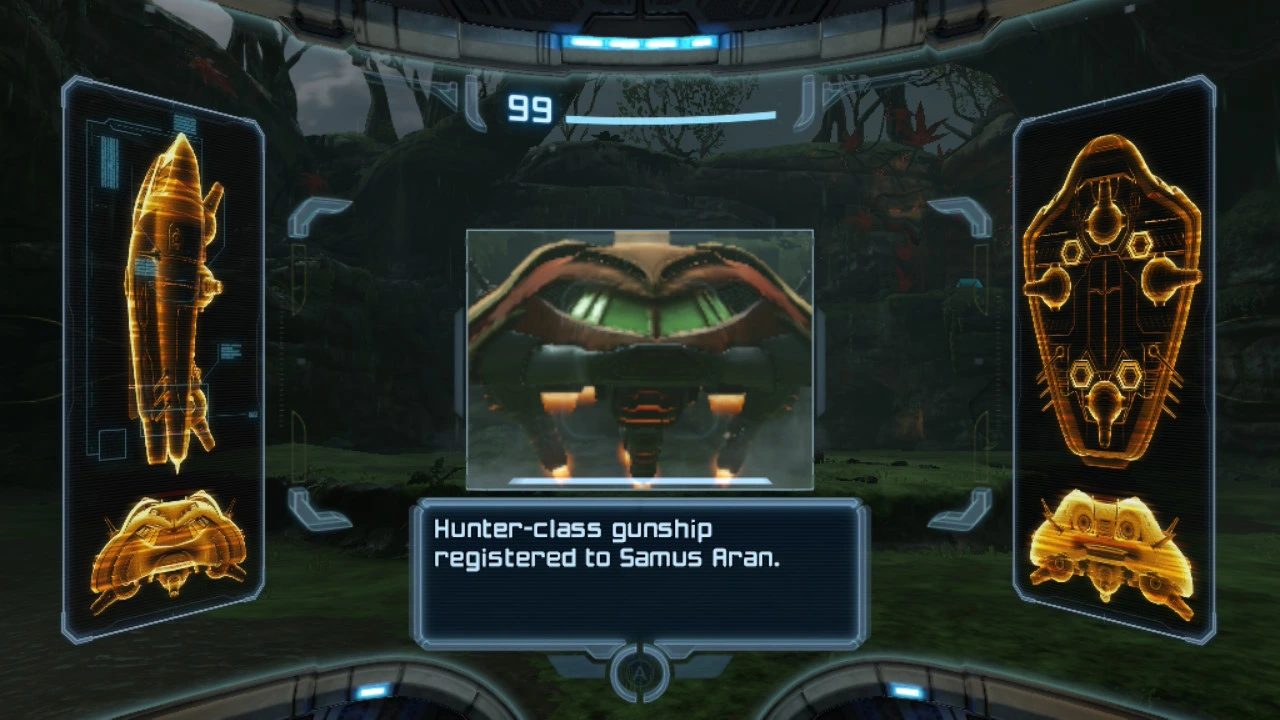
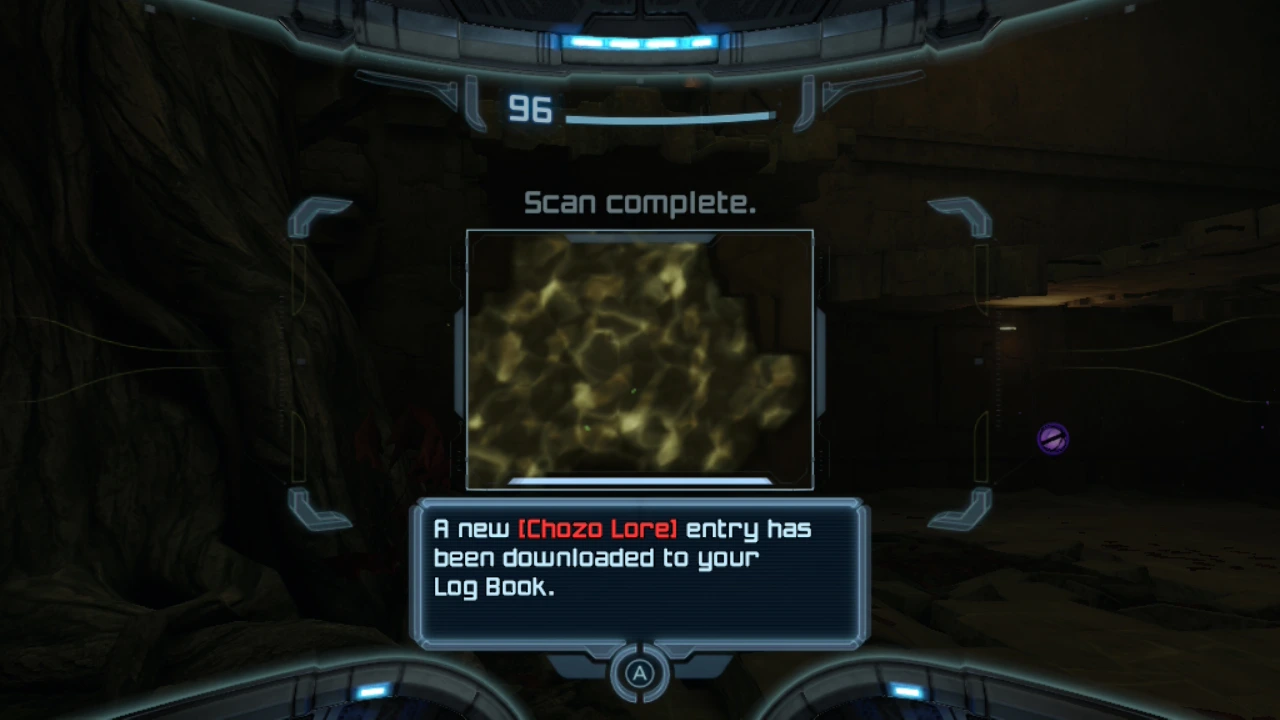
Gunplay is worth mentioning too, as it helps to set Prime apart from the first-person shooter genre at large. It differs control-wise depending on what version of Prime you're playing, but the core of it remains the same, and wholly unique in the realm of first-person games. Samus' arm cannon shoots small Power Beam energy projectiles as it's main attack, but early on in her adventure she can also swap modes to concussive missiles, and many other weapon variants I won't spoil here. What's unique about Samus' weapon is that the game's default view, the Combat Visor, features an L-targeting lock-on system. Think 3D Zelda, but with a gun instead of a sword. You can lock on, strafe, and dodge as you'd expect, without having to manage the camera; Samus will keep her weapon trained squarely on her target. In its original form on the GameCube, switching weapons was on the C-stick, so it couldn't be used for dual-analog controls. Instead, Samus controls like a tank using the left stick, and depends heavily on the lock-on system to stay on target.
Any Objections, Lady?
Fans of the shooter genre - a genre to which, again, Prime doesn't belong - will dismiss this as drastically inferior to other control systems, and in some ways perhaps that's true. To that argument's credit, the remaster on Switch employs a hybrid system that features both dual-analog control and L-targeting. On the surface this feels like the optimal way to control Samus, if we're being honest. However, Metroid Prime and its combat scenarios were built around Samus' control scheme in its original form. The enemies move in a way that is complementary to how Samus moves. They don't often rush you as a group, either, giving you the time and space to be deliberate in aiming your weapon of choice and making movement decisions. Even using a GameCube controller, you never feel like you're lacking freedom of control that you ought to have. It's a unique solution to a hardware limitation, and it works great in context.
In fact, there are some reasons why the GameCube iteration may have a leg up on its modern remaster. In all versions (Wii excluded), visor switching is on the D-Pad. However, in the remaster's move to dual-analog, the weapons could no longer exist on the right stick. Retro's solution to this problem was to make holding the X button switch the mode of the D-Pad from visors to weapons, until the X button is released. It works, but you have to take both your thumbs off the sticks to perform the maneuver, so you briefly sacrifice the ability to move or aim when you want to change your weapon. The original is unorthodox, but it also doesn't have this problem, so I have to give it the advantage here. I'd rather have unconventional movement that doesn't get interrupted than modern controls that force you to stop just to change a weapon. To be clear, Metroid Prime Remastered is still the definitive way to play this game. It's not a deal breaker by any means, but it is too bad a better solution couldn't have been designed in this particular instance. If it bothers you enough, the remaster offers alternate control schemes that attempt to emulate the GameCube's control scheme, and for real purists, the game does mostly support the GameCube Adapter with a bit of tinkering in the settings menu.
In the ways laid out above, despite its imperfections, Metroid Prime manages to stand tall on its own as something wonderfully unique, and becomes the first-person adventure that Retro and Nintendo promised. It's a slower, more cerebral experience than the Halos and the Call of Duty's of the world. You're not just gunning down enemies because they're "bad guys". More often than not, you're simply defending yourself, desperately, against local predators, as you try to find your purpose in a given region. Every new area you find yourself in is a battle not just for survival, but for understanding. Tallon IV rewards those with a curious nature. Players who don't take advantage of the knowledge being offered by Tallon IV may find themselves lost in its depths without context or a sense of direction, for much longer than they would otherwise be.
One might make the argument, however, that being lost on Tallon IV might not be so bad; it's a gorgeous place, after all. Each of the planet's biomes are visually and aurally arresting. Tallon Overworld's lush jungle feels alive and cleansing, and the sound of the rain among the trees and the cries of local creature dial the immersion all the way up. Chozo Ruins' claustrophobic hallways and ancient machines offer a stark counterpoint to the largely organic Overworld, and Phendrana's wintry silence stands in contrast to the Ruins in turn. These are just a few of the main environments Samus will need to traverse, each with distinct personalities, yet cohesive as a believable place, on a planetary scale. Each region manages to avoid feeling like its ticking off boxes on a list of biome tropes by having a believable reason for existing. By scanning your environment, you'll pick up on context clues that explain how a given area found itself in its current state.
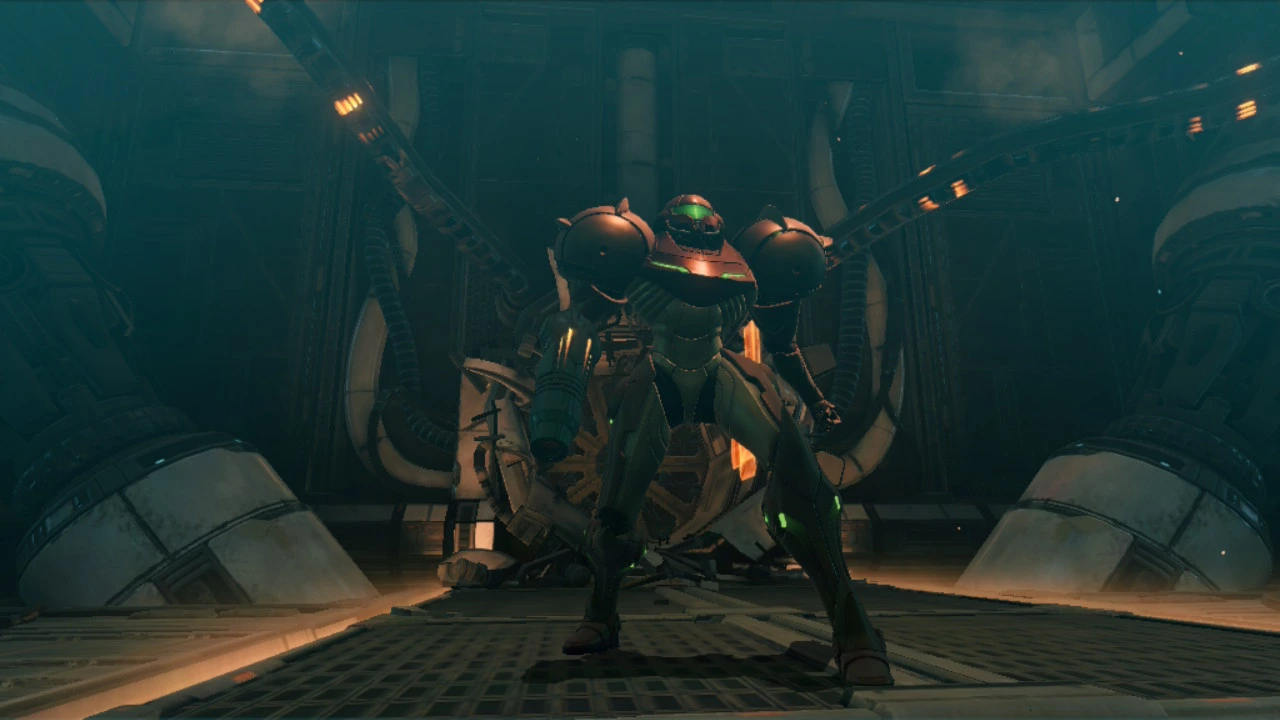
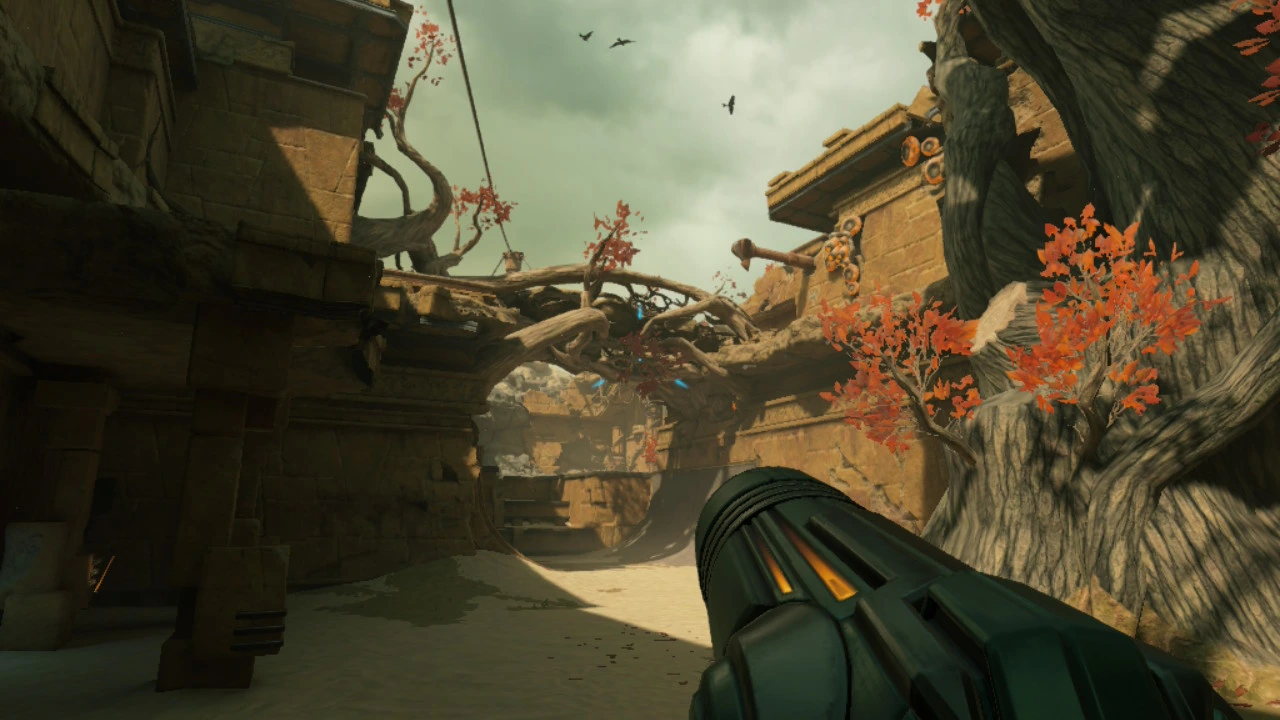
These regions are all exquisitely paired with music that sets a pitch perfect pace and tone at every turn. The Chozo Ruins, for instance, features a driving drum machine beat and electric bass to push Samus forward, paired in a beautiful juxtaposition with an angelic choir. This choir is the soundtrack's anchor point, and can be heard throughout Samus' adventure, nearly everywhere she goes, whether it's deep underground or into a frigid tundra, and almost everywhere in between. The only places you won't really hear the choir are those that have been ravaged by industry or by Space Pirates - the places where the world has died. In these places, mechanical industrial soundscapes rule the airwaves. This coexistence of, and juxtaposition between, organic and mechanical, between familiar and mysterious, is a major theme of not just Tallon IV, but also of Samus Aran as a character. She is a human being, but her Power Suit and her high-tech Chozo upbringing makes her something more. Something largely unknowable even to her. This endless struggle of the understood versus the exotic is at the core of all the best Metroid games, and Prime drives the idea home with its presentation. It does so in a way that I don't think has been executed as effectively before or since in a video game.
See You Next Mission
Metroid Prime isn't a perfect video game, but for my money, it's damn close. Even on the GameCube, its audiovisual presentation was unparalleled, and Prime Remastered on the Switch 1 elevates the visuals even higher while leaving the core experience almost entirely intact. It's a triumph of game design, a shining example of player conveyance, and a masterclass in translating a 2D genre into 3D. As a player, you do have to meet Metroid Prime where it is; I freely admit that there's a disconnect between this game's systems and the conventional understanding of what a first-person game should be. However, if you can move past your preconceived notions, and allow yourself to experience Prime as the carefully measured sci-fi exploration adventure that it is, rather than a guns-blazing shooter, I truly believe you'll find something wondrous buried just under Tallon IV's surface.
I go back to Metroid Prime every few years, and the sheer joy and wonder of experiencing Samus' first 3D adventure never really fades. If this review convinces even one person to get into Metroid Prime, and if that person goes on to play other Metroid games as a result, I'll have done my job, and my galaxy will be at peace.